

Sightings in the CVWG area 2023
MARCH
Alice Naish has sent in a video of a Barn Owl quartering a rough field off Radford Hill, taken at about 4 pm on 2nd or 3rd March this year by Jackie Cook. Alice sees this beautiful creature at around that time of day in this location quite frequently. The video can be viewed through the following link
https://www.dropbox.com/s/dwdac1x8yeputk0/Barn%20Owl%20quartering_Jackie%20Cook.mp4?dl=0

Alice also reports that there have been many sightings of a pair of Red Kites building a nest in a huge conifer in the grounds of Parish’s House, Timsbury.
Jeremy Walwin has sent in a video of a Barn Owl at dusk, taken in Hardington in Mid-March. Jeremy also reported seeing up to eight Red Kites near his house in the second half of March.
Tap on the text in the centre of the image below to view his video.

Rob Ladd – Red Kite seen over Greyfield Wood, High Littleton on 30th March at 14.00
Deborah Porter’s observations and ‘firsts’ of the year at Lower Whitlelands, Radstock include:
16th March – in song were Chiff-chaff, Great Tit and Song Thrush
17th March – a pair of Ravens overhead; Pied Wagtails have gone now; sparrows chirruping enthusiastically; first Hairy-footed Flower-bee (Anthophora plumipes), a male
18th March – first Common Green Furrow-bee (Lasioglossum morio) female at primrose; first Gwynne’s Mining Bee (Andrena bicolor) male at Lesser Celendine; Queen Buff-tailed Bumblebee (Bombus Terrestris); Zebra Spider and Pied Shieldbug; first Grey Wagtail in the road; Wren in song; Robins in song; Chiff-chaff in song; Blue tits and Long-tailed Tits busying about; Buzzards and 2 Ravens overhead; Jackdaws carrying nesting material
19th March – first Early Bumblebee (B. pratorum); first two female Hairy-footed Flower-bees (Anthophora plumipes)
22nd March – first lizard of the year, well-grown, dark, with long tail tapering to a fine point warming itslef in the sun on a log; first Brimstone butterfly, male; first Red-tailed Mason Bee (Osmia bicolor), a shell-nester
23rd March – first Common Carder Bee (Bombus pascuorum); first Dark-edged Bee-fly (Bombylius major) at primrose; Dunnock in song
23rd to 27th March – there is a bee (or possibly two of them) that looks like it is probably an Andrena species that we have not seen here before, but I can’t catch it to see!
29th March – the first wave of Martins, a flock of about 140 at a guess, in light rain and poor visibility feeding above the Radstock Sewage Works and Writhlington Batch. Possibly all House Martins, but there may be a handful of Sand Martins mixed in. Sand Martins have been observed here before in the earliest waves, most likely fuelling up on their way to the Avon Gorge. No sign of them on 30th March.
30th March – Osmia bicolor male observed nectaring at Lesser Periwinkle, Vinca minor, a garden plant.
31st March – a few House Martins flying above Sewage works and Writhington Batch
APRIL
1st April – 6 House Martins, Radstock Sewage Works – Deborah Porter
2nd April – first Bombus lucorum agg. (aggregate) queen seen in the garden this year, probably White-tailed Bumblebee (B. lucorum) rather than B. magnus or B. cryptarum – Deborah Porter
3rd April – Brimstone in Greyfield Wood – Rob Ladd
3rd April – three ‘firsts of the year’ in the garden – Ashy Mining Bee, Andrena cineraria, male; female Red-tailed Mason Bee, Osmia bicolor, investigating a snail shell; and male Blue Mason Bee, Osmia caerulescens, warming itself on dark soil on a south-facing slope – Deborah Porter
4th April – two ‘firsts of the year’ in the garden and one over Radstock Seware Works – a female Blue Mason Bee and a female Small Nomad Bee, Nomada falvoguttata; two Swallows appeared above Radstock Sewage Works at 4. 45 pm, the first seen by Deborah this year, accompanied by one House Martin. 4 more House Martins appeared, but none were visible by 6 pm. Several Red-tailed Mason Bees are now out and about in the garden hunting for suitable empty snail shells to nest in. One Red Kite observed thermal circling above Writhlington Batch and the field east of Lower Whitelands – Deborah Porter
5th April – about 30 Swallows and 2 House Martins flying above Writhlington Batch, Radstock Sewage Works and the gardens of the bottom rank of Lower Whitelands; Raven calls coming from Woodborough; two Song Thrushes and still singing in Lower Whitleands gardens – one in the top rank and one in the bottom rank – Deborah Porter
6th April – one more ‘first of the year’ in the garden – a queen Red-tailed Bumbelbee, Bombus lapidarius; a third lizard has appeared, this time not a large fully-grown one or one of medium size, but a small plump one; four male Dotted Bee-flies were sunning themsleves in a small patch in the late afternoon sunshine, two of them less than two inches away from each other; Raven thermal circling and calling above Lower Whitleands – Deborah Porter
MAY
21st May – species recorded in the meadow on the CVWG Insect Walk
Flies – Epistrophe elegans, male; Cheilosia albitarsis, male, at buttercup
Butterflies – Holly Blue, a White (not a good enough view to say which one)
Beetles – Cantharis rustica (a species of soldier beetle), a small leaf beetle (5 mm length) that is a type of flea beetle of the genus Altica, Harmonia axyridis, the Harlequin Ladybird
Bees – Andrena chrysosceles, the Hawthorn Mining Bee, male, Bombus pascuorum, the Common Carder Bee (a worker)
Shield Bugs and Squash Bugs – Palomena prasina, the Green Shieldbug, Coreus marginatus, the Dock Bug
Moths – Micropterix aruncella, female, a micro-moth, at buttercup
27th May – Alex Montacute, Wellow Brook
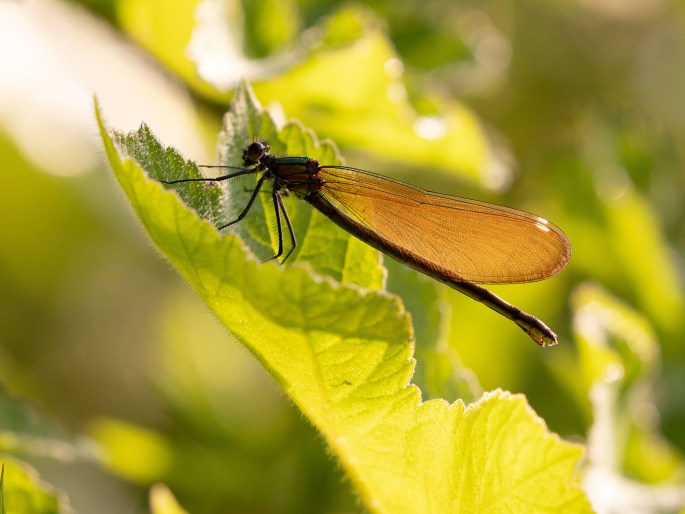
Alex captured the following insects on camera by on the Wellow Brook between Shoscombe and Wellow: Female Beautiful Demoiselle, a female Four-spotted Chaser, a Mayfly and a striking fly that is a good wasp mimic – see our insect gallery for all four photos (please note that no photos on our website are to be used without the permission of the owner)
JUNE
20th June – Eileen Malcher saw a Red Kite flying over the reserve at about 10.30 am as she arrived home in the car. It was being mobbed by two crows.
 Cam Valley Wildlife Group