

barn owl update, July 2025
Just to let everyone know this has been the worst year for Barn Owls in the 16 years I have been doing the conservation work that I can remember.
Owlet production in the nests that are ongoing is well down. I’m missing so many of what would be rock steady, traditional sites. The pairs are still present and gone into molt, and may breed. This is a glimmer of hope, as if conditions improve then they can and will start breeding, very late. This is what happened in 2013.
Vole-rich margins reveal the reason why fresh green grass is missing – the normal thickness of grass has seen much open space opening up. Voles are losing cover and the food they need.
We need rain before the grass growth starts to shut down. Nature needs to heal itself, and quickly, before winter.
Gary Kingman, Barn Owl Conservation, CVWG, July 2025
CVWG and Barn Owl Trust Reports 2024
CVWG report
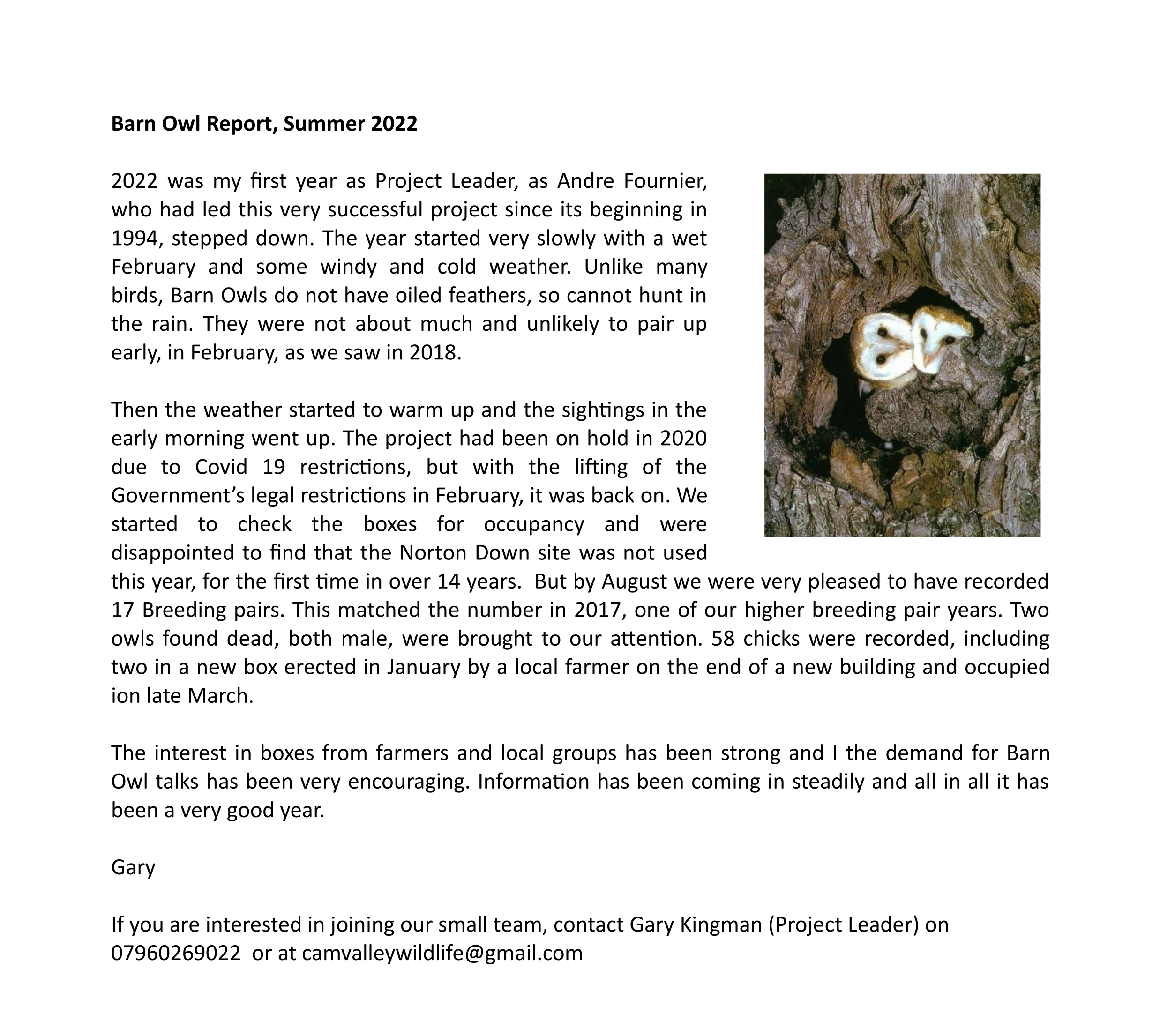
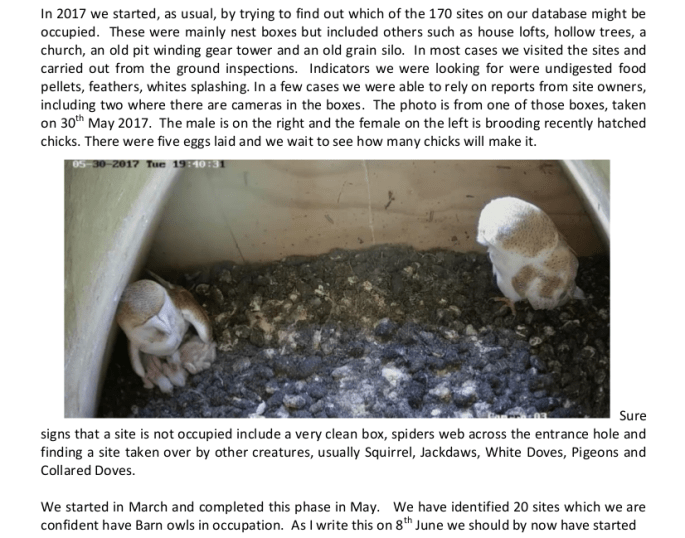
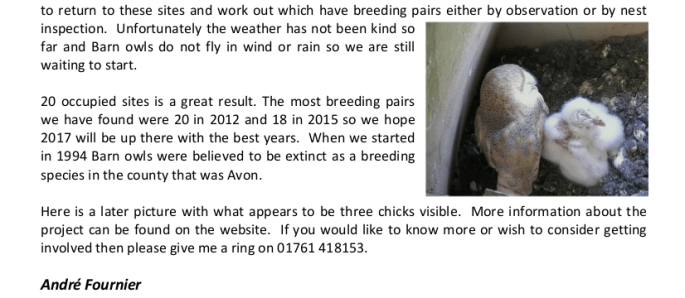
We had good weather overall, though it was hit and miss. Barn Owl numbers were up, with 20 boxes occupied out of 93 boxes monitored. This is a good number, comparable with the 20 breeding pairs in 2012 and the 18 in 2015. Brood numbers were good and included one brood of seven chicks, caught on camera in an owl monitoring box. Five of these fledged, matching our highest count of fledglings in one box from 2018. The nest boxes are checked when the chicks are well grown and not far off fledging.


This year we put up twelve new boxes. We are getting lots of interest from the talks I do and the group’s stalls and reports of Barn Owl sightings are going up. There is also lots of interest from farmers, who often hear about our project through word of moth. They pay for the boxes, we put them up with their help and we monitor them. Some of the farmers let us know when they see the owls going to the boxes, which is a great help. Over the thirty years that the project has been running we have found that many boxes are not occupied by pairs regularly, although many more boxes than the number of pairs are needed as by the time that the chicks fledge both the male and the female are usually using other roosts by then – it can get quite crowded in the box!

The total number of young this year was 67, the highest we have recorded so far, which averages out at over 3 per box occupied. This tops the average for fledging of between 2.5 and 3, so good news for Barn Owls.
Finally, a big thank you to Diana and Tony for all their help over the year and monitoring at Lime Kiln Farm.
Gary Kingman
Contact details: Gary Kingman on 07960269022, at camvalleywildlife@gmail.com, or use our contact form.
State of the UK Barn Owl Population 2024 – a good year for Barn Owls
The Barn Owl Trust has been producing an annual population report, State of the UK Barn Owl Population, since 2013. Cam Valley Wildlife Group is pleased to be a longstanding contributor and would like to highlight this report and the important role of local independent groups across the UK in its production.
The breeding success of Barn Owls varies enormously from year to year depending on conditions, particularly the weather. The average number of owlets fledging the nest is around 3 in the UK but they can raise much larger brood sizes (broods of 7 and 8 are sometimes recorded) or several broods in a season. In poor years they may have a high failure rate or not even attempt to breed. This year Cam Valley Wildlife Group had and impressive seven owlets in one of the broods, five of which fledged. The group’s average for the year was 3.35 fledged, which is above the national average. The Trust described the 1,789 Barn Owl nests monitored in 2024 as “impressive” and noted that nesting occupancy was 39% above average, topping last year’s results and matching those numbers seen in 2022. The CVWG nest occupancy rate was nearly 70% above average this year.
Many groups reported that nesting began very early in 2024. As with the last few years, the UK once again had an incredibly mild winter and spring which potentially resulted in an increased number of birds surviving the winter and able to get into breeding condition early. This promising start was not followed up with above-average brood sizes country-wide, however, remaining very close to the average with an overall increase of less than 1%. This is consistent with the national picture over the past few years. Factors highlighted by the Trust were the possibility that birds breeding early were caught out by periods of rain during the spring, reducing the amount of food supplied to the nest, and a fairly extended breeding season with birds that began nesting later in the year possibly finding their brood size limited by the dry summer.
The Barn Owl Trust views local and regional monitoring schemes as vital in understanding the population fluxes of Barn Owls. We are one of the 48 independent monitoring groups that contributed to the 2024 national report. Of those groups, we have been monitoring the longest – since 1995 in fact! Our area sits within the South West Region, which had had mixed results with some counties reporting above average occupancy and brood sizes and others reporting below-average ones.
Statistics for Somerset – Cam Valley Wildlife Group
| Nesting Occupancy | |||||||
| 2024 | Average of All Previous Years (AAPY) | % change from AAPY | Numerical change from AAPY | ||||
| sites checked | nesting | % nesting | sites checked | nesting | % nesting | ||
| 93 | 20 | 22 | 92 | 12 | 13 | 67 | 8 |
| Mean Brood Size | ||
| 2024 | AAPY | % change from AAPY |
| Start year 1995 | ||
| 3.35 | 2.6 | 29 |
[Note: % changes are rounded to whole numbers.]
The full report, State of the UK Barn Owl Population 2024, can be read or downloaded here – https://www.barnowltrust.org.uk/wp-content/uploads/SOUKBOP-2024.pdf. The Trust’s website provides a population overview amongst other things, which include Barn Owl facts and a Kids’ Stuff page.
2023 Report

2022 report
2021 summary results
The Coronavirus pandemic threw up some monitoring problems in 2021, so only 33 boxes were checked that year – that’s about one third of the average number for all previous years. The nest sites were, however, successfully prioritised and the twelve sites occupied was one more than the average of 11 for all previous years. Andre Fournier, who for many years spearheaded this very successful project, has stepped down as Project Leader, turning the lead over to Gary Kingman.
Contact details: Gary Kingman on 07960269022, at camvalleywildlife@gmail.com, or use our contact form.
2020 report
2016 – 2019 reports


WINTER 2018 PROJECT UPDATE
It was a difficult year for Barn owls and for our survey team.  Nationally there seem to have been encouraging signs of owls pairing up earlier than usual in February. However along came the “infamous “Beast from the East” with long periods of snow cover and heavy rain. The feathers of Barn owls are not oiled like those of many other birds. As a result they cannot hunt in rain. It was inevitable that “the Beast” would have an impact on the population. It would have also had a detrimental effect of the vole population – the main food of Barn owls. They live in holes in the ground and many would have been flooded.
The first signs of the impact of all this were reports nationally that breeding had been delayed by 4 or 5 weeks. Then at the time when chicks would have hatched we had the long blistering summer which would also have some impact.
We normally carry out our normal early observations from April trying to determine which nest sites appeared to be occupied. That is done by inspecting the site from the ground looking for signs of splashing and pellets on the ground plus asking the site owner. After that we work out which of the occupied sites have breeding pairs. Sure signs of that are seeing the male bringing in food for the female with visits increasing when the chicks hatch. If we are lucky we also begin hearing the chicks calling form within the nest.
We try to inspect the nests when we estimate chicks to be about 6 weeks old. At that time the male and female will often be using other roosts (It can get crowded in a nest box of other cavity!) but bringing in food for the chicks in the late evening. Inspecting the nests at that time minimises any disturbance. We normally start the inspections in mid June. In 2018, knowing nesting was late we delayed it by 4 weeks until mid July and completed it in 2 weeks.
What did we find? Well we had 17 breeding pairs in 2017. This year we were down to 12. We found:
-
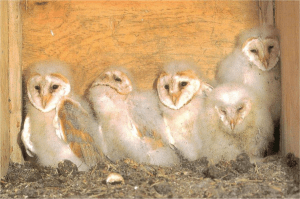 12 sites with successful breeding pairs
 -
2 sites with resident pairs which seem not to have bred
-
4 sites where we observed a single bird present
-
2 sites where birds(s) were reported seen by owners
We counted 30 chicks which is an average of 2.5 per breeding pair. One site had 5 chicks! It should be noted that because we inspect when the chicks are about 6 weeks old it is inevitable that some will have died previously (especially in times of food shortage) and some may die subsequently – the number is therefore a moving target depending on timing of inspection.

In total 20 sites were occupied (compared with 24 in 2017). The population will vary naturally from year to year. All in all, although there was a decrease from last year, it was not as bad as it might have been considering the volatile weather conditions.
In 2018 we again had the pleasure of working with Secret World Animal Rescue to release an orphaned Barn owl chick which they had raised. We used one of the 2016 release sites owned by a very helpful farmer and family. First 2 weeks acclimatising to its new surroundings, in an onsite, custom built, temporary aviary, with a daily supply of dead mice & day old chicks. Then the aviary opened for the bird to return to the wild but with food supply still put out to help it for the next two weeks.
WINTER 2017 BARN OWL PROJECT UPDATE
 In 2017 team members checked 162 sites on our database. So we enjoyed lots of travel to often remote parts of our area. The sites consist mainly of nest boxes which have been erected but include other sites which have enjoyed occupancy in the past such as: buildings; water tower; old pit head winding gear tower and hollow trees. In total we found 24 sites occupied. 17 had successful breeding pairs.
The remaining 7 were: A site we believe was a failed breeding attempt by a new pair; A winter roost of a bird; A single male using temporary roost; A single male in a box erected 2016; A roost for male from nearby breeding pair; A failed breeding where we found 6 abandoned cold eggs and a failed breeding attempt of a pair disturbed by vandalism to the building containing the nest.
A breeding occupancy rate of 1 in 10 sites may  not sound that good but actually it really is. We have a small area of only around 300 sq kms covering Norton Radstock and surrounding villages. Our strategy has been to achieve mass coverage of nest boxes, mainly in barns, so that any newcomer Barn owl arriving in our area would find it quite easy to find a suitable home. There was never an expectation that a large percentage would be used but empty boxes may be used in the future, either as a nest or as a roost for a single bird.
We first identify which sites are occupied. This is done by checking for signs of activity at the site (pellets, feathers, white splashing and by speaking with the site owner. Once established that there is activity we return several times to look for signs of breeding; adults bringing in food and /or sounds of chicks.
 We then try to inspect those sites when we estimate that chicks will be about 6 weeks old. The reason for that is that the adults will probably be using separate roosts away from the nest and returning after hunting to feed the chicks. As a result there is a lesser risk of disturbance. We do not get it right all the time however. This year we went to a box erected in 2016 which we knew was occupied as both parents were bringing in lots of voles for the young. On inspecting the box we found 3 newly hatched chicks all a week old or less. One remaining egg was actually in the process of hatching! We quickly left the site and watched from a distance. We always make a point of inviting the site owner to attend the inspection and this year also encouraged their children on who the impact of seeing the young is wonderful to see.
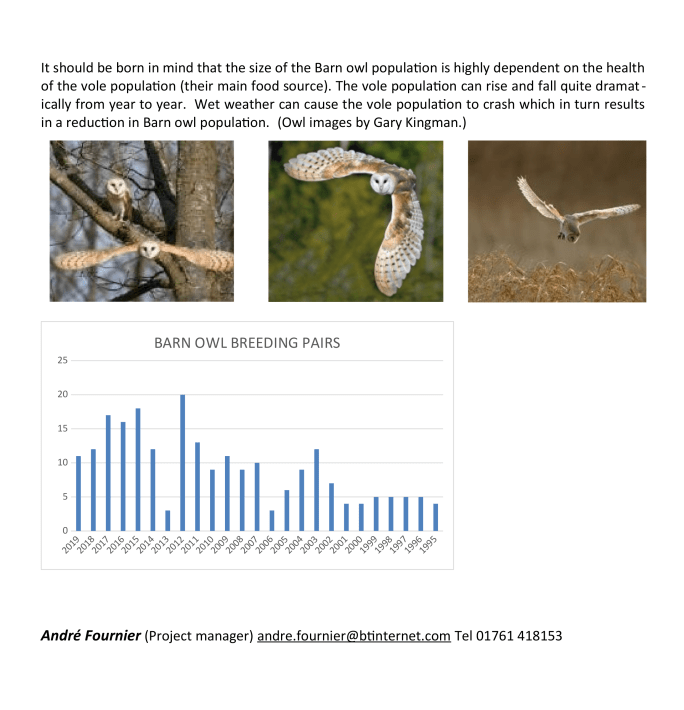
17 nesting pairs in 2017 makes it the 3rd best year since we began. The chart below demonstrates the increase in nesting pairs recorded for each year of the project to date.
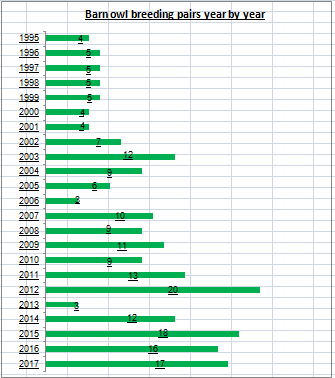 There has been approximately a fourfold increase since the project began which is a splendid result. This could not have been achieved without the help of the helpful 150+ wildlife friendly farmers and other landowners who participate.
The numbers in 2001 & 2006 are not a true reflection of the position. In 2001 there was an outbreak of Foot and Mouth and in 2006 BSE. In both years our work was severely restricted as we could not access farms to check nests. The low number in 2013 reflected the national position when there was an 85% failure of breeding Barn owls across Great Britain which demonstrates the vulnerability of the species.
We did have one major disappointment in 2017. Many if you will probably be aware of a breeding site located in the roof space of a church in our area. Barn owls have bred there every year since 2008 except for 2013. At the start of the 2017 season a pair was in residence and we received many reports of their sighting. Unfortunately during a night in May the church building was vandalised. The capitals were taken from the four posts holding the railings fronting the church. In addition two crosses were removed, one above the entrance porch and one directly above the nest entrance. This must have involved the thieves climbing onto the roof and almost certainly the noise disturbed the Barn owls and caused them to vacate the site. The removed cross was found broken and embedded in the ground below. One theory is that the disturbed owls shot out of the nest and the shock of that caused the thief to drop the cross. The costly damage to the church has now been repaired and we are also receiving reports that the Barn owls seem to have returned – but too late to breed of course.
To end on a very cheery note – on inspecting the 17 breeding nest sites to count the chicks we recorded 50 which is the highest number we have ever recorded.
A reminder: Barn owls are a species afforded protection under the Wildlife & Countryside Act. This makes it an offence to disturb them during the nesting period (March to November) unless working under an official licence. An offence is punishable by heavy fines.
 We will be starting 2018 survey work in late March -If you think you might like to join our small team then please give me a ring on 01761 418153 to discuss. Your enthusiasm is more important than experience.
André Fournier
2017 BARN OWL PROJECT UPDATE
2016 BARN OWL PROJECT REPORT

2016 has been an interesting year for the project with a mix of mysteries, disappointments, surprises and a great deal of enjoyment.
We decided to review our ever increasing database and move some sites to the inactive category, either because they have become defunct or situations have changed such they are not now likely to be used. They remain on the database and will be resurrected if any activity is reported in the vicinity. At the same time we have added new sites where we have erected boxes. We also discovered 6 boxes erected by property owners who have been kind enough to let us include them in our monitoring project.
A few statistics for 2016
- 165 sites were checked at least once, either by visit or by phone call to the site owner
- 21 sites were found to be occupied – a good result as it is normally expected that about 10% will be occupied.
- 18 of those were occupied by a pair & 3 by single birds
- 4 of the pairs failed to breed: 1 laid 5 eggs but male went missing – presume died: 1 male was found with badly broken wing and had to be put down after examination by a vet: 1 was a pair in residence which had not bred when we checked in July – It is possible but unlikely that may have bred later: 1 laid 2 eggs but did not hatch.
- 14 did breed
- 31 chicks were counted (average 2.21 chicks per breeding site)
Previous years
The history of breeding pairs found in the previous 10 years was:
2007 10 2008 9 2009 11 2010 9 2011 13
2012 20 2013 3 2014 12 2015 18 2016 14
14 in 2016 makes it the 3rd best year on record for the number of breeding pairs found (years prior to 2007 were all lower). There has been a continuing increase in the number of nest boxes in place, since the project began in 1994. which has helped swell the population. Numbers vary naturally from year to year depending on breeding conditions (weather, availability of prey and other factors). I have not shown comparative figures for the number of chicks counted in previous years as this is highly dependent on the timing nest inspections – the later we do this the more young chicks will have died especially in years of food shortage.
Late breeding
There has been a greater than normal proportion of breeding failure this year and later laying dates. The extreme example was a pair which still had not laid when we inspected on 21st June. On 12.8 we found 4 newly hatched chicks – so the eggs must have been laid around mid July – so some 10 weeks later than would have been expected. Probable reasons for the lateness and failure rate are: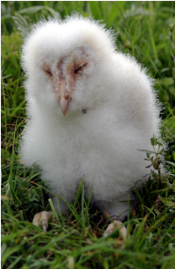
- October 2015– mid January 2016 was a very wet period and this would have reduced the availability of prey.
- In turn that is likely to have increased the death rate of mature birds. (Barn owls only live about 3 or 4 years anyway in the wild).
- 2015 was an exceptional breeding year with lots of chicks hatching. Those which survived the winter would have taken the place of mature birds that died or formed brand new pairs.
- Birds breeding in their first year have a higher failure rate due to their inexperience.
- Egg production by the females takes up a lot of energy and so she needs to increase her weight to 385 grams before egg production begins. The shortage of food in the wet winter and spring would have restricted growth so that some likely did not reach the full weight until later than normal.
Rescue of a lost Juvenile Barn owl
The entrance to the nest box at one site is incorporated at the top of a gable end wall overlooking fields. When we first inspected the box this year, on 18th July, we found a female apparently on three eggs. Great! We revisited 7 weeks later on 6th September expecting to count the chicks but much to our surprise the box was empty, No eggs, no chicks and no adults. The chicks could not have flown as they do not start to make exploratory forays until about 9 weeks old and even at that age they stay close to the nest. A mystery!
Next day I received a phone call from the site owner to say that a Barn owl was sat on the sill of the window immediately below the nest entrance, so we rushed out to it, As we put up the ladder the owl dropped to the ground amongst shrubs but after a search and a brief chase along the ground we managed to capture it. We took it to the local vet to help examine it. There appeared to be no bones broken, it did not appear to be in pain and was not emaciated. So next day we returned it to the nest which it entered very eagerly. Over the next week we had a couple of dusk watches from a distance and were delighted to see both adults and 3 juveniles all playing around the property while being fed by the parents.
But why had the nest been empty on 6th September? Conclusion: The eggs found on 18th July must have already hatched but sitting in the debris on the floor of the box they appeared whole. Also we found that the box had moved over the years and that left enough of a gap for the chicks to be enjoying, out of sight, the freedom of the whole attic! Over the winter we need to discuss with the owners what corrective action is best.
Working with other organisations
Cam Valley Wildlife Group has always been keen to work with other like minded organisations. As far as the Barn owl project is concerned we have worked in liaison with The Hawk & Owl Trust for 22 years now since. Our own area overlaps with their Bath Group and Mendip Group areas both of which are large. They have been happy for us to take on the work so they have more time to concentrate on the remainder of their areas. Each year we provide details of our survey results to them.
Since 2012 we have been helping with the Somerset Wildlife Trust project to put up a new Barn owl box up in each of the 335 parishes in their area. We were pleased to help with the 15 parishes which lie in our area, finding suitable sites, erecting the boxes and now monitoring them as part of our project.
This year we formed a new alliance with well known Secret World Wildlife Rescue located at Highbridge in Somerset. They contacted me about 4 Barn owl chicks to see if we could find suitable release sites for them when they were old enough. A lorry driver had picked up bales of hay from a farm but when he reached his destination he heard chirping and discovered 4 just hatched pink and helpless chicks in the bales. He quickly took them to Secret World. Unfortunately the smallest died but the other 3 developed well under their care. A 4th chick from a different site was brought in. It was about the same age as the other 3 and so they were able to integrate it with them. We soon found a very suitable site at a farm with a very helpful farmer where we had a nest box in which Barn owls had nested in the past but not lately.
 A 5th Barn owl was then taken in at Secret World. This was older than the others so another release site was quickly found. At both sites all the owner families were extremely supportive and keen to be involved. We helped Secret World erect temporary 7 metre aviaries into which first the 4 and then the 5th were placed for two weeks to acclimatise. During this time food, dead mice & chicks, had to be put in the aviary, by the
 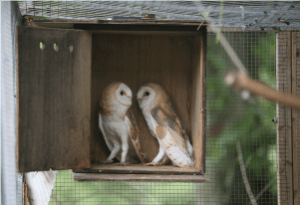 families, from the supply that was kept in their freezers. After 2 weeks, at dusk the aviary doors were left open. Next morning the Barn owls had left, hopefully to find their own territories and mate. This has been the first time that Secret World and Cam Valley Wildlife Group have worked together in this way and we hope that it will not be the last. Combining knowledge and expertise and working with such wildlife friendly farm owners has been an object lesson in teamwork.
Andre Fournier (Project Leader) 01761 418153 Photographs courtesy of Gary Kingman (except the chick)
With many thanks to the many local helpful farmers and other landowners who make our work possible
For results in years prior to 2016, please go to the project history page
 Cam Valley Wildlife Group